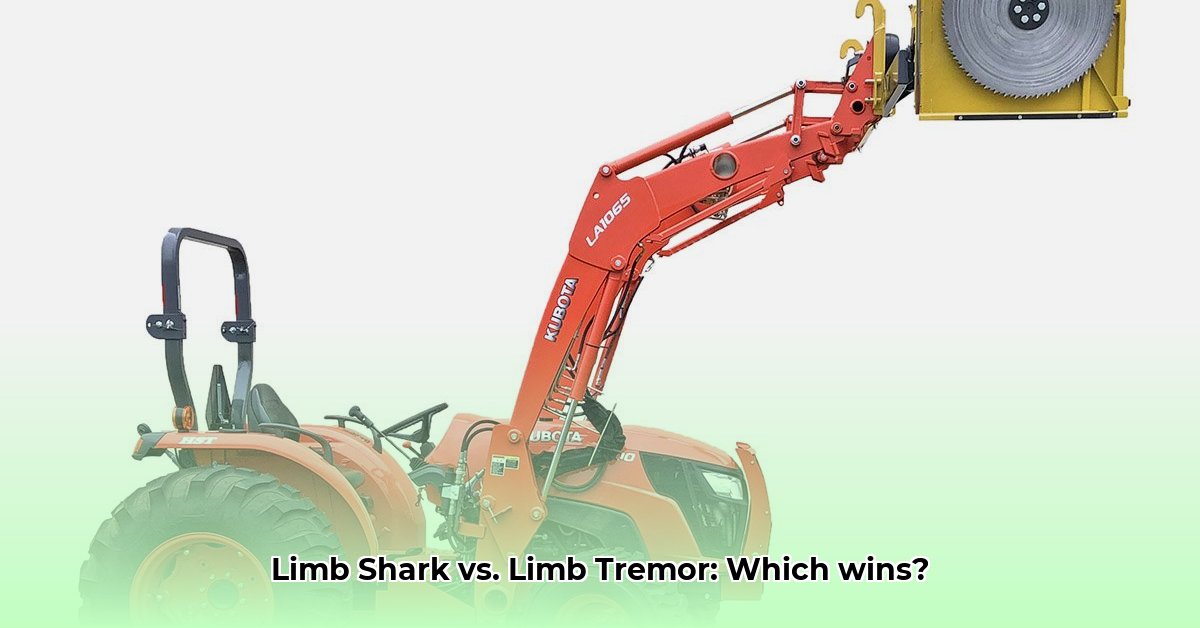
Choosing the right tractor-mounted limb trimmer significantly impacts efficiency and safety. This comparative review analyzes two popular options: the LimbShark and the Brown Products Limb Tremor, providing actionable insights for agricultural professionals and equipment buyers.
Branch Busting Capabilities: Size Matters
The first crucial factor is cutting capacity. The LimbShark, with its four 12-inch blades, efficiently handles branches up to 3 inches in diameter. This makes it ideal for smaller properties or clearing light brush. The Limb Tremor, however, targets larger jobs. Its MPT30 and MPT40 models utilize a powerful saw blade, tackling swaths up to 30 and 40 inches wide, respectively. This is the difference between a hedge trimmer and a chainsaw; the LimbShark trims bushes, while the Limb Tremor clears larger trees. The Limb Tremor also boasts a reach of up to 13 feet, extending its cutting capacity to high branches. While the LimbShark's reach isn't explicitly specified, its design emphasizes flexible angling. Which cutting capacity best suits your needs?
Power Source: Hydraulics or PTO?
Power delivery is another key differentiator. The LimbShark offers self-contained (6.5 HP and 8 HP) or tractor/skid steer hydraulic options (requiring at least 8 GPM flow). The Limb Tremor relies solely on the tractor's power take-off (PTO) system, employing a Danfoss hydraulic motor (10 or 15 GPM, depending on the model). Notably, the Limb Tremor's hydraulic motor operates at approximately 75% of its full capacity, a design choice likely enhancing durability. Before purchasing, verify your tractor's capabilities for optimal compatibility with either machine. Do you have a high-flow hydraulic system, or are you relying solely on PTO power?
Cutting Styles: Rotary vs. Saw Blade
The LimbShark uses a rotary cutter with multiple blades, effective for smaller branches, but potentially providing less precise cuts than the Limb Tremor’s saw blade. The saw blade delivers cleaner cuts and reduces potential hazards associated with blade ejection. Consider the desired precision and the types of branches you'll primarily trim. Will clean cuts be essential, or is sheer cutting speed the priority?
Feature Comparison: LimbShark vs. Limb Tremor
The following table summarizes key features:
| Feature | LimbShark | Limb Tremor |
|---|---|---|
| Cutting Capacity | Up to 3-inch diameter limbs | Up to 30" (MPT30) or 40" (MPT40) swath width |
| Power Source | Self-contained (6.5/8 HP) or Tractor/Skid Steer Hydraulics | Tractor PTO |
| Cutting Mechanism | Rotary Cutter | Saw Blade |
| Reach | Unspecified vertical reach, versatile angles | Up to 13 feet (depending on tractor) |
| Ideal Use Case | Smaller farms, cost-effective solution | Larger operations, precise cutting needs |
Choosing the Right Trimmer: A Decision Framework
For smaller farms, the LimbShark's lower cost and ease of use are attractive. However, larger operations requiring precise cuts and the ability to handle larger branches will likely prefer the Limb Tremor. Always meticulously check tractor specifications for compatibility, focusing on hydraulic flow and power requirements. What is your budget, and what is the scale of your operations?
Safety Considerations: Minimizing Risks
Safety is paramount. Regular maintenance and operator training are crucial for both machines. While the Limb Tremor's saw blade offers precision, careful operation is needed to prevent blade ejection. Maintaining hydraulic systems is essential for both machines. What safety protocols will you implement to mitigate potential hazards?
Key Takeaways: Three Pivotal Points
- Cutting Capacity: The Limb Tremor excels in handling larger limbs; the LimbShark prioritizes speed on smaller branches.
- Power Source: The LimbShark offers more power source flexibility, while the Limb Tremor relies on the tractor's PTO.
- Maintenance: The Limb Tremor might require less frequent maintenance due to its simpler blade system.
This comparative review provides a solid foundation for selecting the optimal limb trimmer. Thoroughly consider your farm's needs, budget, and operational scale to make an informed decision.